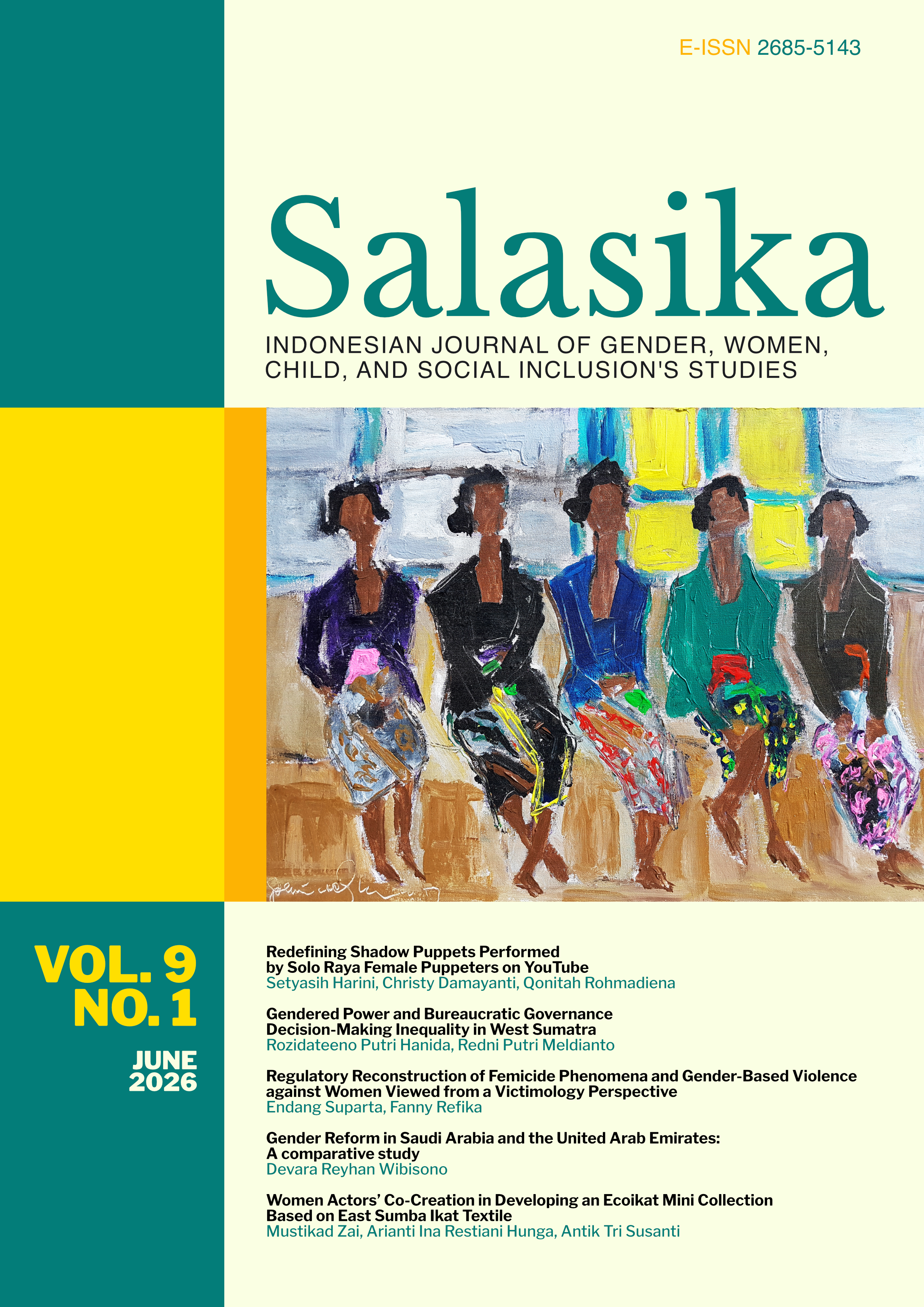
Gender Reform in Saudi Arabia and the United Arab Emirates: A comparative study
Article Sidebar
Main Article Content
Abstract
Article Details

This work is licensed under a Creative Commons Attribution-NonCommercial-ShareAlike 4.0 International License.
Please find the rights and licenses in Jurnal SALASIKA: Indonesian Journal of Gender, Women, Child, and Social Inclusion's Studies. By submitting the article/manuscript of the article, the author(s) agree with this policy. No specific document sign-off is required.
- License
The non-commercial use of the article will be governed by the Creative Commons Attribution license as currently displayed on Creative Commons Attribution-NonCommercial-ShareAlike 4.0 International License.
- Author(s)' Warranties
The author warrants that the article is original, written by the stated author(s), has not been published before, contains no unlawful statements, does not infringe the rights of others, is subject to copyright that is vested exclusively in the author and free of any third party rights, and that any necessary written permissions to quote from other sources have been obtained by the author(s).
- User Rights
SALASIKA is to disseminate/published articles are as free as possible. Under the Creative Commons license, SALASIKA permits users to copy, distribute, display, and perform the work for non-commercial purposes only. Users will also need to attribute authors and SALASIKA to distributing works in the journal and other media of publications.
- Rights of Authors
Authors retain all their rights to the published works, such as (but not limited to) the following rights;
- Copyright and other proprietary rights relating to the article, such as patent rights,
- The right to use the substance of the article in own future works, including lectures and books,
- The right to reproduce the article for own purposes,
- The right to self-archive the article,
- The right to enter into separate, additional contractual arrangements for the non-exclusive distribution of the article's published version (e.g., post it to an institutional repository or publish it in a book), with an acknowledgment of its initial publication in this journal (SALASIKA: Indonesian Journal of Gender, Women, Child, and Social Inclusion's Studies).
- Co-Authorship
If the article was jointly prepared by more than one author, any authors submitting the manuscript warrants that he/she has been authorized by all co-authors to be agreed on this copyright and license notice (agreement) on their behalf, and agrees to inform his/her co-authors of the terms of this policy. SALASIKA will not be held liable for anything that may arise due to the author(s) internal dispute. SALASIKA will only communicate with the corresponding author.
- Royalties
Being an open accessed journal and disseminating articles for free under the Creative Commons license term mentioned, author(s) aware that SALASIKA entitles the author(s) to no royalties or other fees.